
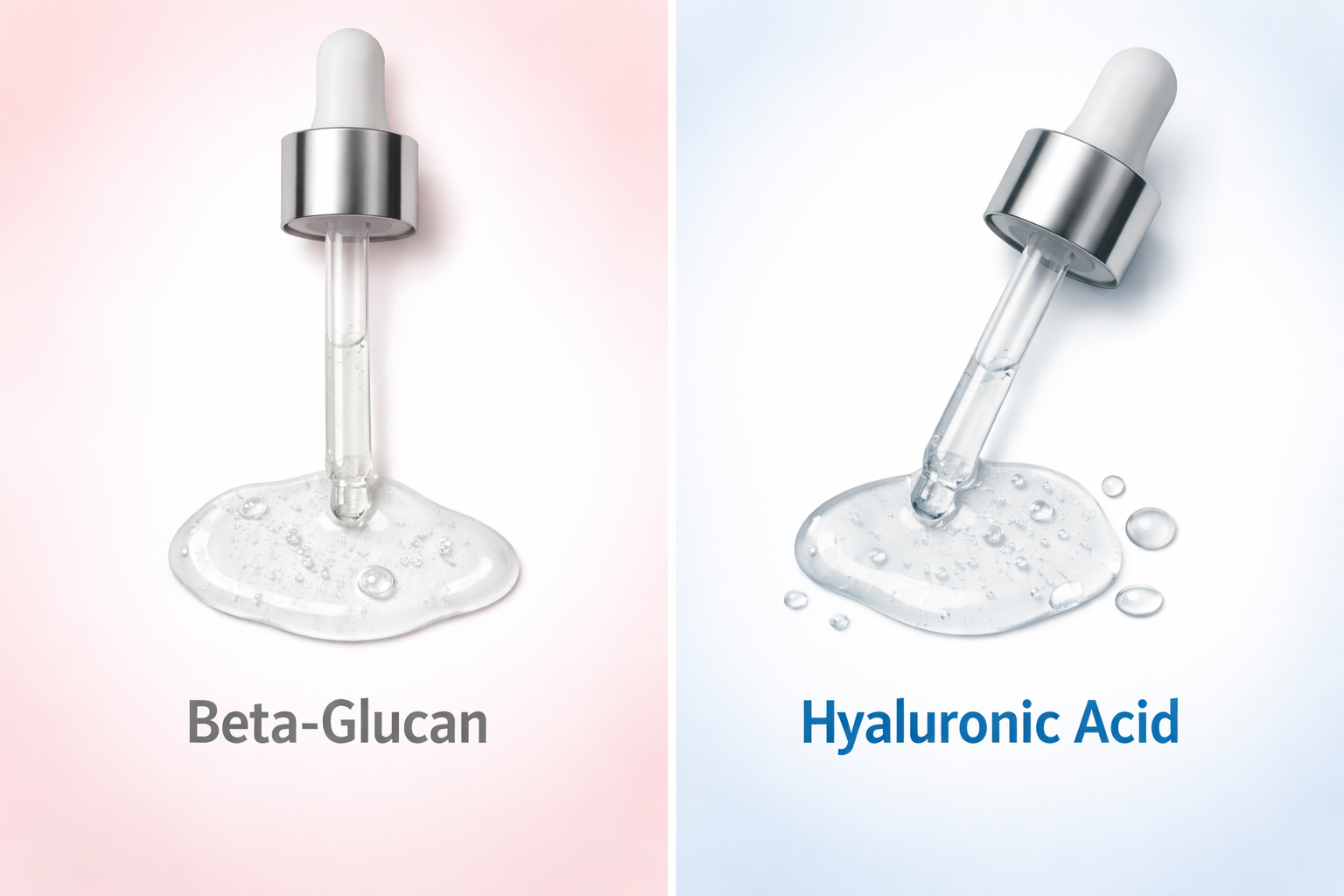
Moisturising and hydrating ingredients are a staple in any skincare routine, even for oily skin girlies like myself. For a long time, I thought hydration would make my skin greasier. Ironically, the opposite happened. Once I focused on supporting my skin barrier, my oil production actually became more balanced and my redness reduced.
Beta-Glucan and Hyaluronic acid are two of the most talked about hydrating ingredients in skincare but they work in different ways. One focuses on short-term water binding. The other focuses on long-term barrier repair.
What are they?
Beta-Glucan is a naturally occurring polysaccharide found in oats, mushrooms, yeast and grains. It forms a protective film on the skin.
Hyaluronic acid is a naturally occurring molecule in your skin and connective tissues. It is known for its ability to hold up to 1000x its weight in water allowing it to attract moisture to the surface layers of the skin
What do they do?
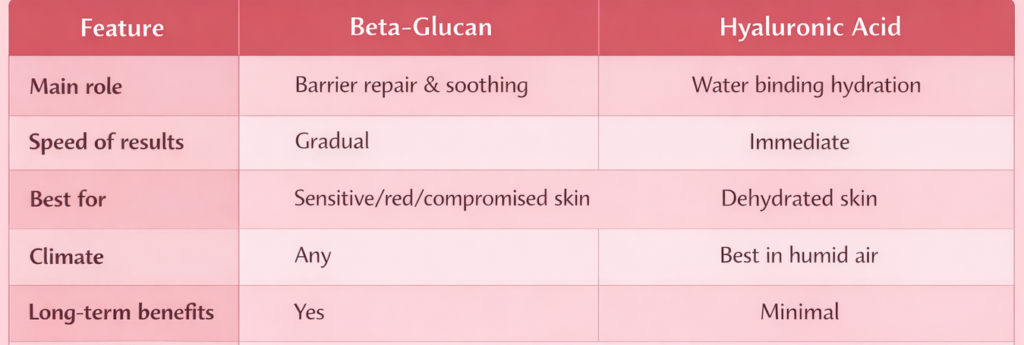
Beta-Glucan does not attract water, instead it helps strengthen the skin barrier itself. A stronger barrier reduces water loss, improves resilience, and decreases inflammation over time. So rather than quick hydration, you get gradual, longer-lasting skin health.
Benefits of Beta-Glucan:
- Calms irritation and inflammation: great for redness, sensitivity and rosacea prone skin
- Supports skin barrier repair and resilience
- Boost collagen and skin healing
Overall, the primary function of Beta-Glucan is barrier repair and soothing the skin in the long term.
Hyaluronic acid functions as a humectant, meaning it pulls water toward the outer layers of your skin. This creates an immediate plumping and smoothing effect, which is why your skin looks glowier within minutes. However, this effect is temporary and depends heavily on the environment and the presence of a moisturiser to seal it in.
Benefits of Hyaluronic acid:
- Intense hydration: attracts moisture to skin layers
- Increases skin plumpness and reduces the appearance of fine lines
Overall, the primary function of Hyaluronic Acid is instant hydration in the short term.
Which one is right for you?
- your skin feels dehydrated or tight
- you want instant glow and plumpness
- you live in a humid climate
- your skin is sensitive or red
- your barrier feels damaged
- you overuse actives
- your skin is oily but dehydrated
- you want longer-term repair
How to use Hyaluronic Acid the right way
Hyaluronic Acid must be used correctly to avoid drying out your skin. You should:
- Apply to damp skin
- Always seal with a moisturiser
- Avoid relying on it as your only hydrating step
My Recommendation
Hyaluronic acid is basically in every skincare product by now so you don’t need a dedicated hyaluronic acid serum. There is also a risk with using hyaluronic acid where in dry climates such as air conditioned rooms, this ingredient can draw moisture from deeper skin layers to the surface leaving your skin effectively dryer and lead to your skin feeling tight over time. Furthermore, the benefits of using hyaluronic acid are short lived, it stops the moment you stop applying the serum, it does not repair the skin barrier.
Nevertheless, hyaluronic acid remains a useful hydrating ingredient as long as you pair it with barrier-supporting products, apply it correctly and use it in the right environments.
Beta-Glucan offers a more holistic approach for those dealing with sensitivity, redness or oiliness caused by weakened skin barrier. For this reason, if I had to choose between the two it would be Beta-Glucan, but if you could incorporate both into your skincare routine, even better.
Product recommendations
Beta-Glucan: iUNIK Beta Glucan Power Moisture Serum
Hyaluronic Acid: Innisfree Ultra-Low Molecular Hyaluronic Acid Serum
This blog is for informational purposes only and does not replace professional dermatological advice. Individual skin responses may vary.