
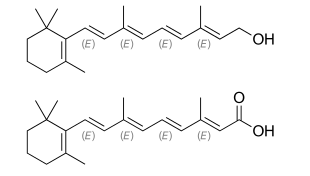
Retinol is one of the few skincare ingredients that dermatologists consistently recommend because it is backed by decades of clinical research. Unlike trendy actives that promise quick fixes, retinoids actually change how skin cells behave at a biological level. But most people don’t realise that retinol isn’t just one ingredient, it is part of a family of vitamin A derivatives, each of different strengths, irritation levels and results. So if you’re trying to treat acne, fine lines, pigmentation, or uneven texture, understanding which vitamin A derivative to choose can make or break your results.
This guide breaks down every retinoid type, explains how they work biologically and helps you choose the right one for your skin type.
Retinoids are Vitamin A based skincare powerhouses with many derivatives. Each derivative has the same goal but with different levels of effectiveness and side effects. You definitely want to know the type of retinol to use and at what concentration to avoid your face from flaking and you regretting your life decisions.
Retinoids work by binding to speciifc receptors in skin cells, promoting epidermal turnover, stimulating collagen production and regulating pigment production. This combination of effects helps improve acne, fine lines, wrinkles and uneven skin tone over time. Stronger Retinoids provide faster results but carry a higher risk of irritation.
I have outlined the common retinol derivatives and the pros and cons of each from weakest to strongest.
Bakuchiol
A plant based derivative so technically not a vitamin A derivative but I thought it would be worth mentioning because it mimics the benefits of retinoids.
Pros:
- Very gentle, no peeling or irritation
- Pregnancy safe
Cons:
- Results are subtle and slow
- Ineffective against acne and deep wrinkles
Retinol aka the classic
The most popular OTC vitamin A derivative and the one most beginners start with. It needs to undergo two enzymatic conversions to become active and convert into Retinoic acid.
Pros:
- Improves fine lines, skin texture and tone and acne
- Most studied vitamin A derivative
- Easily accessible
Cons:
- Slow results as it undergoes multiple conversions
- Can cause dryness, mild peeling and irritation
- Not pregnancy safe
Retinal aka Retinol’s younger and hotter cousin
It only needs to undergo one enzymatic conversion to become active and convert into Retinoic acid.
Pros:
- See results faster than Retinol
- Strong anti-aging and acne benefits
- Often better tolerated than expected
Cons:
- Can cause dryness and irritation but less than retinol
- More expensive and harder to find
- Not pregnancy safe
Adapalene aka the acne annihilator
Used to require prescription but recently approved as an OTC retinoid.
Pros:
- Effective at treating acne and clogged pores. Comparable to prescription strength acne products
- More stable and less irritating than other prescription retinoids.
Cons:
- Less effective for anti-aging
- Can cause dryness, mild peeling and irritation
- Not pregnancy safe
Retinoic Acid aka Tretinoin aka the trifactor
No enzymatic conversion, it is already in its active form.
Pros:
- Effective at treating acne, wrinkles and pigmentation
- Quicker results
- Long term skin transformer
Cons:
- High risk of irritation, redness and peeling
- Prescription only
- Not pregnancy safe
Tazarotene aka the final boss
Synthetic vitamin A derivative that is the most potent.
Pros:
- Extremely effective for acne, psoriasis and photoaging
- Works fast and aggressively
Cons:
- Very high risk of irritation, redness and peeling
- Prescription only
- Not pregnancy safe
Which one is right for you?
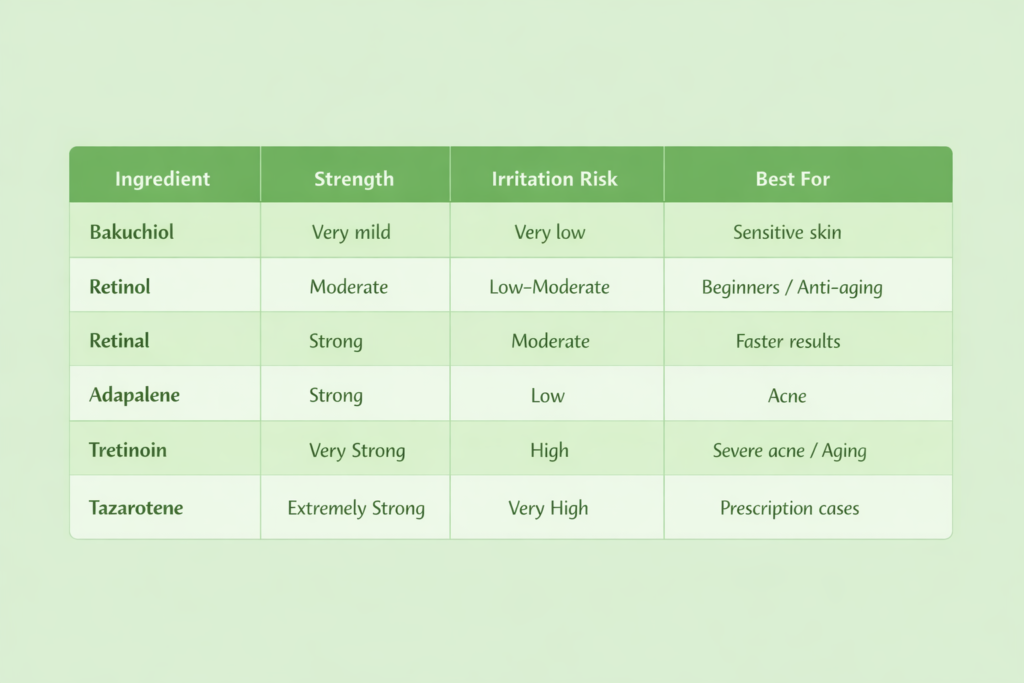
Use & Results
Good skin is a marathon, not a chemical peel
Always patch test new Retinoid products. Start out slow because the side effects can be nasty and definitely worse than the skin condition you were previously trying to treat. For OTC retinoids when it comes to choosing which concentration to use start with the lowest concentration, stick with it for several months and only after you don’t experience any irritation should you increase the concentration.
I first tried The Inkey List Bakuchiol cream and it did nothing for my skin and had an odd smell. However if you have very sensitive skin it is worth a try.
Then I tried a retinol and applied it every other day for around two months before applying it everyday and always using the Retinol sandwich method. The instructions on the bottle said 1-2 pumps at first I used 2 pumps for about a year but then I got badly sunburnt once and eliminated every active from my skincare routine until it healed. Once it healed my skin still felt sensitive so I started using only 1 pump of retinol when I introduced all the actives back into my skincare routine. To this day, two years later I’m still only using one pump everyday because I find that I see the same results but with less irritation AND each bottle lasts me twice as long!
Realistic timeline on what to expect:
- Week 1-2: Mild dryness and irritation as you slowly build up tolerance
- Week 3-4: Smoother skin texture
- Week 8-12: Brighter skin tone and fewer breakouts
- Month 3-6: Reduction in fine lines and bouncier skin
Retinols are slow burners, anyone promising overnight results are lying.
Common mistakes people make
- Using too much
- Starting daily
- Mixing with acids
- Skipping SPF
- Quitting too soon
This blog is for informational purposes only and does not replace professional dermatological advice. Individual skin responses may vary.